The Ultimate Guide to Omnichannel Retail for High-Consideration Brands
What clienteling is, how it works, and the technology and strategy it takes to make it pay — written for luxury and high-consideration brands — jewellers, watch shops, showrooms, tailors — whose sales take weeks, a conversation and somebody who remembers.
Free, with no form to fill in: one click and the 24-page PDF is yours to keep and pass round your team. Or see what's inside first.
- The five layers of technology a single client record stands on
- A playbook for each stage of a sale that takes weeks
- Ten moments worth getting in touch, and whose list each one lands on
- Follow-up and sales-credit rules your team will accept
- A 90-day rollout plan and a 15-question scorecard

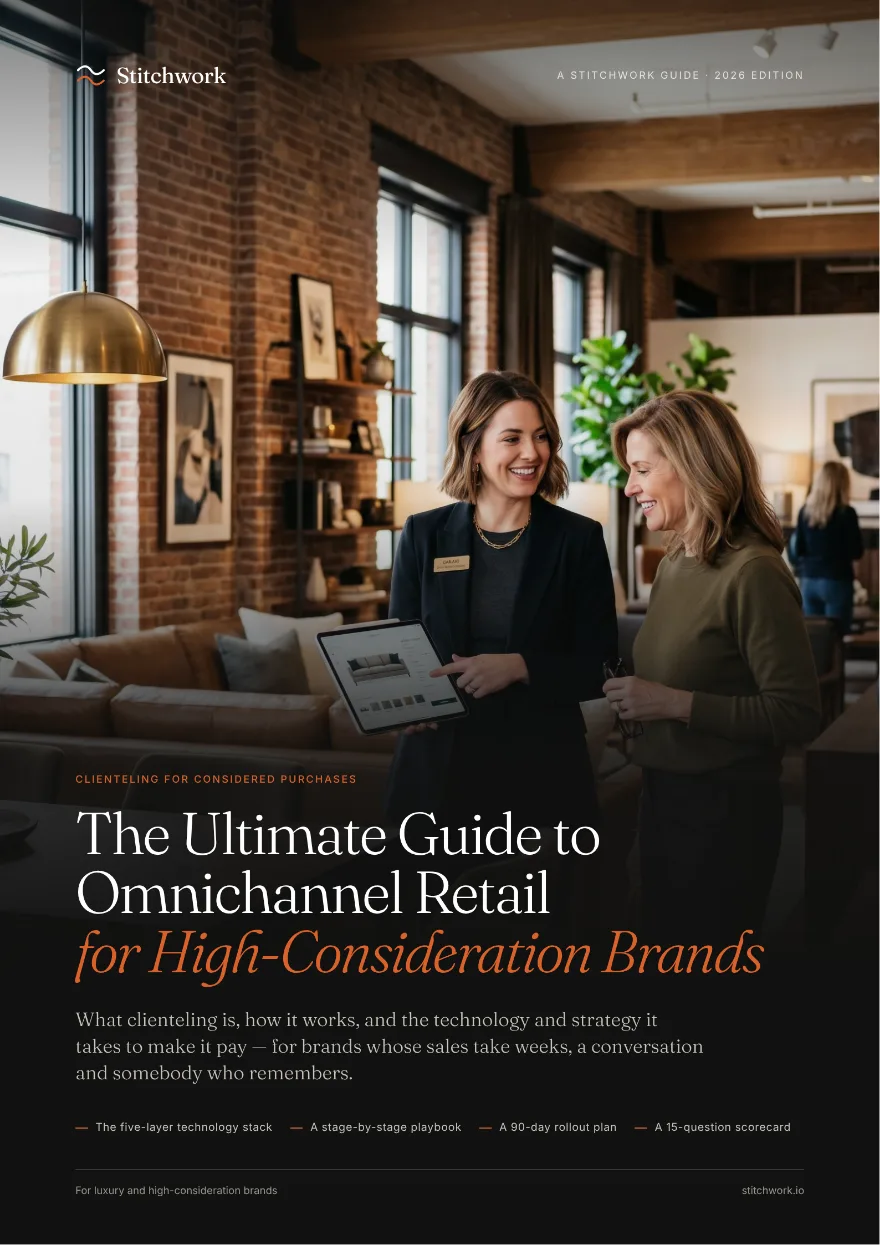
Twelve chapters, from the first visit to the second sale.
Most of it works whatever software you use, and some of it works with none. Where it helps, it shows how Stitchwork does each part.
- 01
The considered purchase
One customer, three weeks, five touchpoints — and two versions of the same Saturday.
- 02
Where it slips away
Six leaks between the website and the floor, and the incentive problem underneath them.
- 03
What clienteling is — and isn't
Selling from memory, and how it differs from a CRM, a loyalty scheme and marketing automation.
- 04
The omnichannel clienteling stack
Capture, identity, the record, action and proof: five layers of technology, each with a test.
- 05
The strategy
Six stages of a considered purchase, the move for each, and where the second sale comes from.
- 06
The moments that matter
Ten reasons to be in touch, when each one comes round, and whose list it lands on.
- 07
Follow-through, and who gets the credit
Why task lists fail, five rules that make follow-up stick, and a credit split people accept.
- 08
Messages, consent and trust
One person writing to one person, from the record, with permission you can show.
- 09
AI in clienteling
What an assistant is good for, and five rules for pointing AI at customer data.
- 10
Optimise and measure
Order-value ranking, holdout groups, attribution that counts the showroom, and ten numbers to watch.
- 11
How Stitchwork puts it together
The five layers in one product, and what your client sees on their phone.
- 12
Your first 90 days
From a notebook to a business that remembers, a month at a time.
+ The scorecard: fifteen questions to put to one real client's record, and what your score says to do next.
Chapter 11 shows how Stitchwork puts the five layers together. To see them on screen now, take the five-minute product tour: one week at a watch shop, in eighteen real screens.


For brands where people buy from people.
Founders, managing directors and heads of retail at brands with showrooms, studios or ateliers, where four things are true at once:
- The order is worth a conversation — usually four figures or more.
- The decision takes weeks, with research online and at least one visit in person.
- People sell it: associates, designers, stylists, fitters, specialists.
- There's a quote, a fitting or an appointment, not just a basket.
Watches & jewellery · Bridal · Furniture & interiors · Kitchens & bathrooms · Tailoring & made-to-measure · Musical instruments · Art & galleries
Nothing in the second version needed a better salesperson. It needed the business to remember.
From chapter 1, The considered purchase

Four questions, answered.
Get the guide.
Twenty-four pages, a 90-day plan and a scorecard to take into your next team meeting. No form and no email address: it's yours.